Trade Show Displays and Signs: How to Stand Out at an Exhibition
Trade Show Displays and Signs: How to Stand Out at an Exhibition
A sales director attending her company’s first major trade show appearance recently described the moment she understood what she was actually competing against. Standing at the booth they’d set up – a standard 10×10 configuration with a retractable banner, a table with a printed tablecloth, and a stack of brochures – she looked left and right down the aisle and saw companies of roughly similar size with constructed booth environments: backlit display walls, dimensional logo elements projecting from the display structure, well-lit product displays, and clearly branded overhead elements that identified each company from thirty feet away. Her booth, which had looked reasonable in the warehouse where it was assembled, looked like a folding table at a flea market by comparison. She didn’t make a single useful contact that day. The following year, the company invested in a proper trade show booth display – a modular backwall with an integrated dimensional logo, two flanking display panels, and a well-lit product counter. They generated more leads in one day of that show than they had in their entire first year of trade show participation combined. Trade show displays are one of the most directly competitive environments a business brand encounters, and this guide covers exactly what makes the difference.
Why Trade Show Displays Are a Different Signage Challenge
Trade shows put business brands in direct, side-by-side comparison with competitors in a way that no other marketing environment replicates. On a street, your sign competes with the visual noise of an urban environment. At a trade show, your display competes with the sign immediately to your left and the sign immediately to your right, and the people evaluating those signs are actively comparing them – consciously or not – as they walk the aisle.
Trade show displays need to accomplish several things simultaneously that most other forms of business signage don’t: they need to identify the company from a distance (wayfinding function), communicate what the company does quickly enough that a walking visitor can decide whether to stop within two or three seconds (messaging function), create an environment that rewards stopping and engaging (experiential function), and leave a visual impression distinctive enough to be remembered later in a day when the visitor will have walked past dozens of similar booths (memorability function).
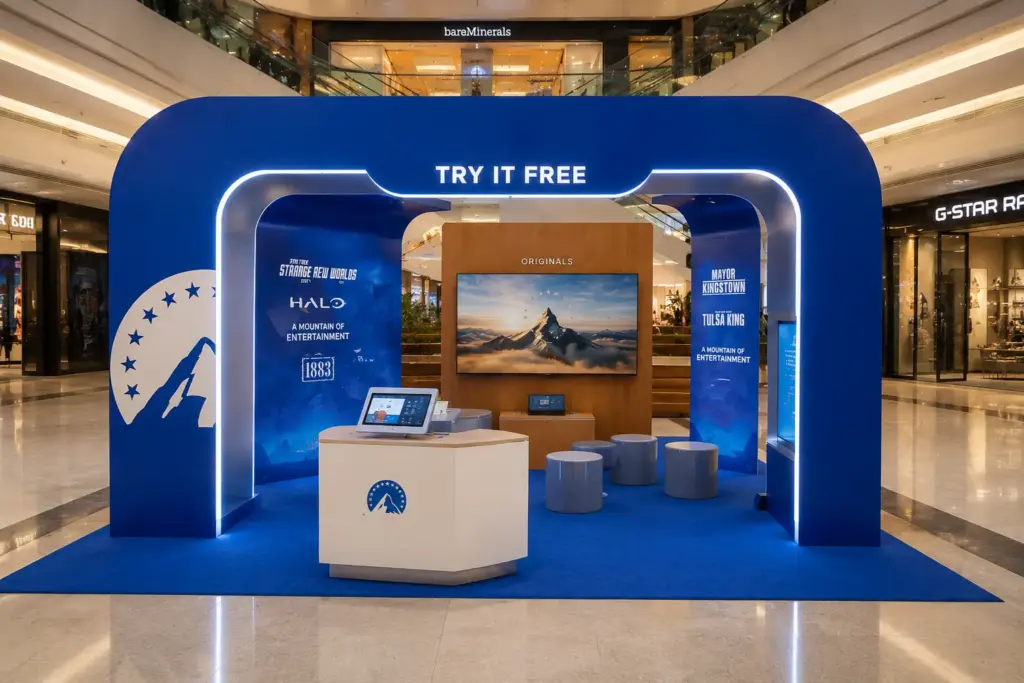
Displays for trade shows that succeed across all four of these functions share consistent characteristics: a clear, large-format company identification element visible from the aisle at forty feet or more; a secondary message that communicates the core value proposition in one brief phrase; a physical display environment that creates visual depth, dimensionality, and lighting that makes the booth feel like a destination rather than a flat backdrop; and a branded material consistency that links every element – the display structure, the signage, the product presentation, the collateral – into a cohesive visual identity.
Trade show booth design that ignores any of these functions typically underperforms in specific and predictable ways: booths that only solve the identification function generate brand awareness without leads; booths that only solve the messaging function communicate content but don’t attract attention in a high-stimulation show floor environment; booths that only solve the experiential function create great conversations but only with the visitors who already stopped for other reasons. The most effective trade show booth displays solve all four simultaneously, which is why they consistently produce the disproportionate lead generation results that the sales director’s second-year experience illustrated.
Types of Trade Show Signs and Display Structures
Trade show displays fall into several structural categories, each suited to different booth sizes, budget levels, and brand presentation requirements.
Retractable banners are the most portable and least expensive trade show display format – a printed banner panel that rolls down from a compact base unit. They’re effective as supplementary display elements within a larger booth environment but are rarely sufficient as primary identification and display elements in competitive trade show environments, precisely because their flat, portable format doesn’t create the visual depth and dimensional presence that constructed displays provide. The retractable banner is ubiquitous at trade shows partly because it’s inexpensive and convenient, not because it performs well – understanding this distinction helps businesses invest their display budget more effectively.
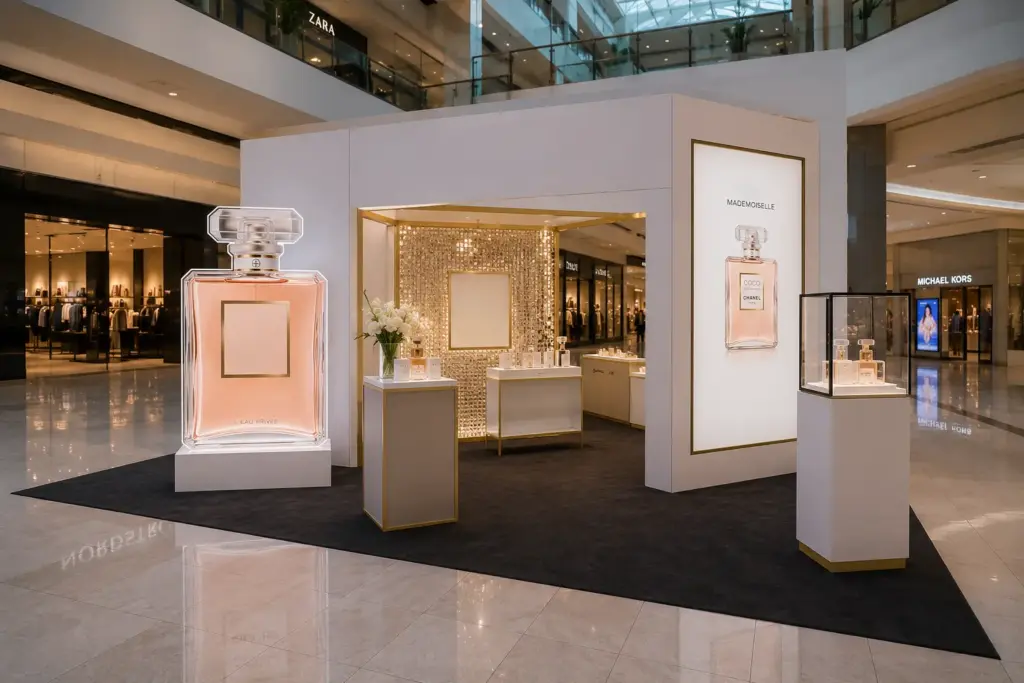
Backwall display systems – constructed display panels that form the rear wall of a booth space – are the foundational element of most serious trade show display environments. They range from simple tension fabric displays (a fabric graphic stretched over an aluminum frame) to modular hard-panel systems with integrated shelving, lighting, and dimensional graphic elements. The key distinction in backwall quality is the presence of dimension: a flat fabric print forms a backdrop, but a backwall with dimensional logo elements, depth-creating panel overlays, and integrated spotlighting creates a visual environment rather than simply a backdrop.
Display booths for trade shows with dimensional logo elements – raised letters, projected logo marks in acrylic or foam, or built-up layered panel compositions – consistently outperform flat-printed equivalents in the attention metrics that matter at trade shows: the number of attendees who stop and look (dwell events), the number who stop and engage (conversation events), and post-show brand recall among attendees. The dimensional quality creates visual interest that flat graphics don’t, particularly under the typically high-intensity overhead lighting of convention center floors.
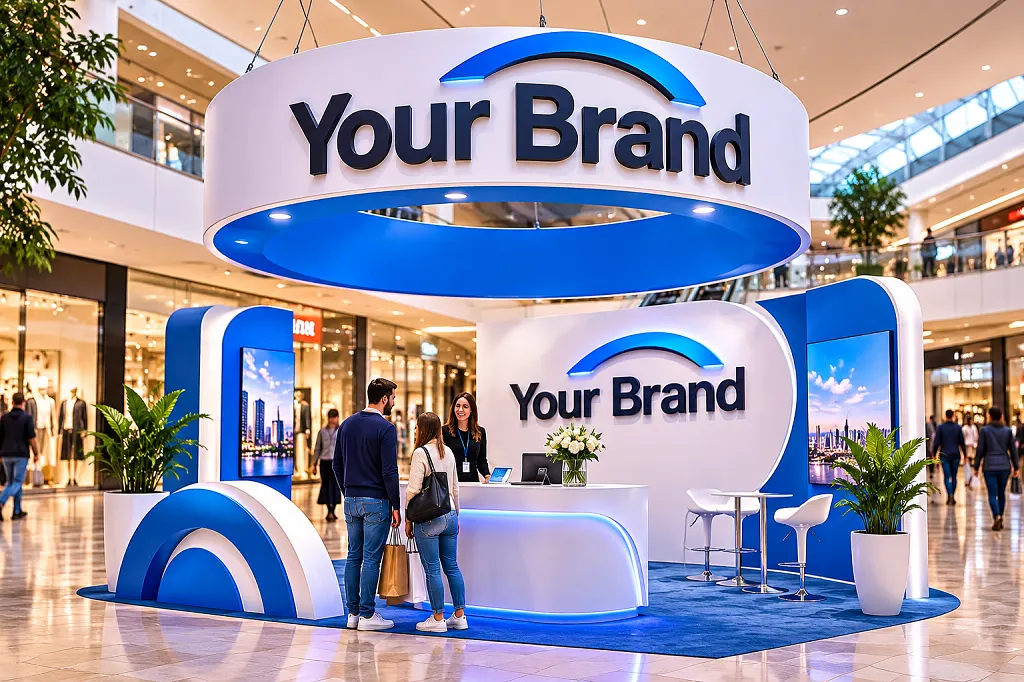
Trade show booth displays for larger 20×20 or island configurations introduce additional structural elements – overhead hanging signs visible from even greater distances, freestanding display towers, lit counters and product display pedestals – that together create an environmental presence within the show floor rather than simply a booth along an aisle. These configurations require more significant planning, fabrication lead time, and installation coordination, but for companies where trade shows represent a primary customer acquisition channel, the investment consistently justifies itself in lead quality and volume.
Portable vs. modular vs. custom is the primary trade show display decision for most businesses entering or upgrading their trade show presence. Portable systems (retractable banners, pop-up displays, tension fabric systems) prioritize ease of transport and self-assembly; modular systems use standardized components that can be reconfigured for different booth sizes and layouts; fully custom displays are designed and built specifically for a company’s brand and display requirements. Most established trade show exhibitors find that a modular system with custom-branded graphic panels and key dimensional elements hits the balance between flexibility and visual impact that fully portable systems can’t achieve and fully custom systems require more budget than most companies can sustain.
Designing Trade Show Signage for Maximum Impact
Trade show booth design for visual impact starts with visibility at aisle distance, not at arm’s length. The most common design mistake in trade show display graphics is creating content optimized for reading at close range – detailed text, small images, complex charts – rather than for recognition at the fifteen to forty feet of aisle distance from which most attendees make their initial booth evaluation decision.
Trade show booth display graphics that work at aisle distance follow a clear hierarchy: the company name or logo at the largest scale, dominating the top portion of the display where it’s visible above the heads of people walking the aisle; a short primary message (typically five words or fewer) at a scale readable from across the aisle; and product images or secondary information at a scale appropriate for interested visitors who have stopped and stepped closer. This hierarchy is intuitive when stated explicitly but is regularly violated in trade show display design by clients who want to communicate everything rather than just the things that matter from the distance where decisions are made.
Dimensional elements within the display structure – a logo sign that projects from the backwall surface, illuminated letters that stand out from the background panel, or a floating dimensional product feature that creates physical depth within the display environment – are the highest-return investment in trade show display impact specifically because they solve a problem that printed graphics alone cannot: in a row of flat-printed displays, a dimensional element immediately draws the eye because it looks fundamentally different from its neighbors.
Lighting within the display is a detail that separates professionally produced trade show displays from self-assembled alternatives. Convention center overhead lighting is designed for general illumination, not for exhibitor branding – it’s typically flat, high-intensity fluorescent or LED wash lighting that provides adequate visibility but creates no directional quality that enhances product or sign presentation. Adding integrated spotlighting within the booth – either focused on the dimensional logo element, on product displays, or as backlight for the display structure – creates a distinctly different visual quality within the booth space that marks it as a designed environment rather than simply an assembly of display components.
Logistics, Lead Times, and Managing the Trade Show Display Process
Trade show displays involve a logistical complexity that most businesses don’t encounter with their other signage purchases, and understanding this complexity in advance prevents the last-minute problems that consistently compromise trade show participation.
Lead time for trade show booth displays is longer than most first-time exhibitors expect. A basic portable display with printed graphics can sometimes be produced in five to seven business days, but a modular or custom display system with dimensional elements, integrated lighting, and multiple graphic components typically requires three to six weeks of production time. Custom display structures with built-up dimensional elements may require eight to twelve weeks from approved design to delivery. Planning trade show display orders with this lead time in mind – not working backward from the show date and discovering there’s insufficient time for what you wanted – is the fundamental logistics discipline that experienced trade show marketers maintain.
Shipping and logistics for trade show displays involve more complexity than shipping standard signs because displays need to arrive on-site in good condition, be assembled correctly within the booth space, and be disassembled and returned after the show. Most professional display systems include custom shipping cases designed to protect the components in transit and enable efficient assembly at the show site. For companies exhibiting at multiple shows per year, investing in durable, well-designed cases for their display components reduces damage costs and assembly time over the system’s full service life.
Installation and assembly for larger display systems may require contracted labor at the show venue, since many convention centers have union labor requirements for any display above certain height and complexity thresholds. Knowing the labor rules at each show venue before finalizing a display design that requires on-site installation labor is important for accurate total cost planning – labor costs at major convention centers can be substantial and are sometimes comparable to the display fabrication cost itself for complex installations.
Conclusion
The honest takeaway on trade show displays is that the investment differential between a retractable banner setup and a properly designed display booth pays for itself in the quality and volume of leads generated at a single good show. The sales director’s experience in the opening scenario isn’t unusual – it’s the standard result for companies that treat their first trade show as a learning experience and their second as a real marketing investment. The businesses that consistently outperform at trade shows are the ones that design for aisle visibility first, solve for dimensional impact within the booth environment, and plan their display logistics with enough lead time to execute without compromise.
Frequently Asked Questions
What types of trade show displays are most effective?
Backwall display systems with integrated dimensional logo elements, coordinated lighting, and a clear visual hierarchy from aisle distance to close engagement consistently outperform flat-printed alternatives in attention and lead generation metrics. The combination of dimensional quality that creates visual depth, integrated lighting that distinguishes the booth environment from its neighbors, and a strong large-format company identification element visible from forty feet is the standard configuration for high-performing trade show displays across most industry sectors.
How far in advance should I order trade show displays?
Allow a minimum of four to six weeks for modular display systems with printed graphic panels and standard dimensional elements, and eight to twelve weeks for fully custom display structures or those with complex dimensional or illuminated features. For major shows where last-minute orders would require expedite fees or rush production compromises, eight to twelve weeks lead time for any display order is a more reliable standard. Planning your trade show calendar at the start of the year and initiating display orders for each show well ahead of deadline is the practice that eliminates last-minute trade show display crises.
Can trade show displays be reused for multiple shows?
Yes, and designing for reusability is one of the most important cost-efficiency decisions in trade show display planning. Modular display systems with changeable graphic panel inserts allow a company to update show-specific messaging and imagery while reusing the structural and dimensional elements across multiple shows and over multiple years. Designing the display structure to be format-flexible – usable in both a 10×10 and a 10×20 booth configuration, for instance – extends its value across a wider range of show participation options.
What is the difference between a retractable banner and a full trade show display?
A retractable banner is a portable, self-contained display unit with a printed panel that rolls down from a compact base – easy to transport and set up but flat, limited in scale, and visually indistinct from the dozens of other retractable banners on a typical trade show floor. A full trade show display is a constructed display environment with structural elements, dimensional branding, integrated lighting, and visual scale that creates a genuine branded presence within the show floor rather than simply adding a flat graphic element to the booth space. The performance difference between the two, in terms of attention, engagement, and lead generation, is typically substantial.
Read more

Acrylic Letters and Logo Signs: A Practical Guide for Business Owners

Foam Routed Signs and CNC-Cut Signage: When and Why Businesses Choose This Format
Hanging Signs for Trade Show Booths: Weight, Rigging, and Sightlines That Work
Oversized Foam Letters for Events, Retail Displays, and Brand Activations
PVC, Acrylic, or Small Metal Letters: Choosing the Right Dimensional Letters for Your Storefront

Foam Sculptures and Oversized Product Replicas: How Brands Build Unmissable Experiential Marketing

How Backlit and Halo-Lit Signs Turn a Storefront Into a Landmark After Dark

Digital Signage for Business: What It Is and How to Use It Effectively
Sandblasted and V-Carved Signs: The Craft Behind Timeless, Hand-Finished Business Signage

Floating Pool Letters: A Fresh Way to Brand Pool Parties, Resorts, and Brand Activations

Premium 3D Dimensional Signage with Professional Lighting Solutions
Safety and Warning Signs for the Workplace: A Complete Guide for Business Owners
Recommended Articles
Acrylic Letters and Logo Signs: A Practical Guide for Business Owners
Foam Routed Signs and CNC-Cut Signage: When and Why Businesses Choose This Format
Hanging Signs for Trade Show Booths: Weight, Rigging, and Sightlines That Work
Oversized Foam Letters for Events, Retail Displays, and Brand Activations
PVC, Acrylic, or Small Metal Letters: Choosing the Right Dimensional Letters for Your Storefront
Foam Sculptures and Oversized Product Replicas: How Brands Build Unmissable Experiential Marketing