Sandblasted vs. V-Carved Signs: Understanding the Difference in Dimensional Signage
Quick Navigation
- What Are Sandblasted Signs?
- What Are V-Carved Signs?
- Visual Differences Between Sandblasted and V-Carved Signs
- Materials Used in Modern Routed Signage
- Durability and Outdoor Performance
- Which Option Is Better?
- Long-Term Value and Total Cost of Ownership (TCO)
- Frequently Asked Questions
Dimensional signage plays a critical role in how businesses, residential communities, and commercial properties present their identity. Among the most requested architectural signage styles are sandblasted signs and V-carved signs. While both create dimensional effects and a premium appearance, the manufacturing process, visual character, and structural behaviour of these signs are fundamentally different.
Understanding these differences is essential when selecting the right signage solution for long-term durability, branding, and installation requirements.
What Are Sandblasted Signs?
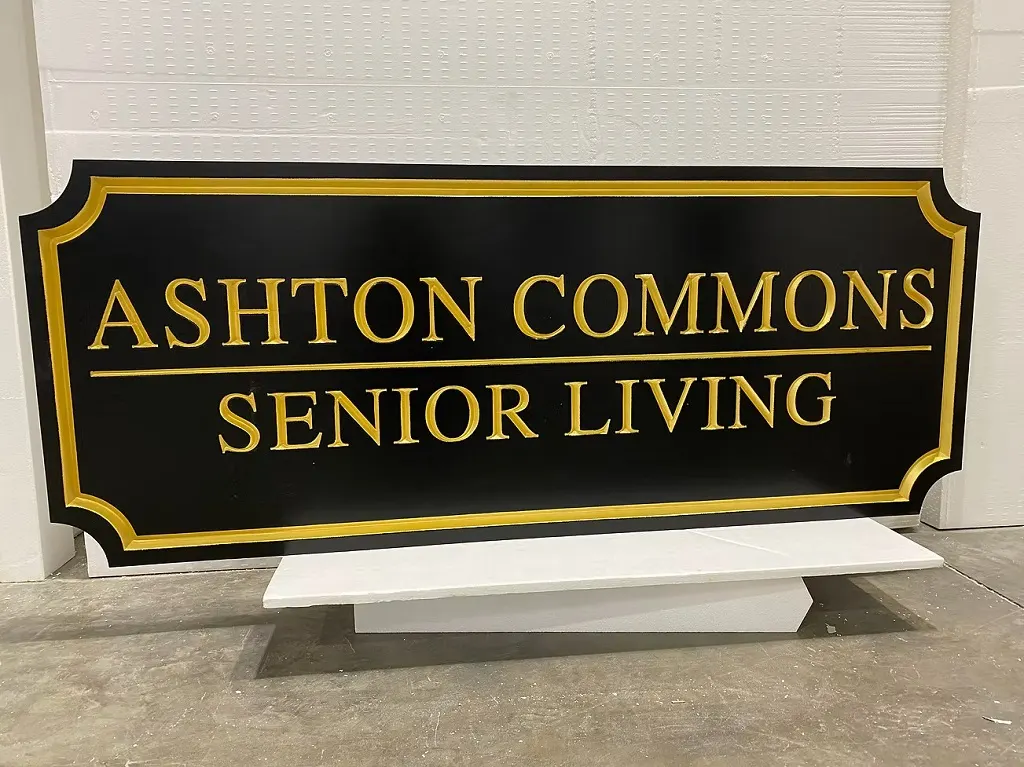
Sandblasted signs are traditionally produced by blasting abrasive material at the surface of a substrate to remove selected areas and create raised or recessed graphics. Historically, this process was most commonly performed on wood, especially cedar or redwood.
The blasting process creates a textured background while leaving lettering and logos raised above the surface. This texture gives sandblasted signs a handcrafted, rustic, and dimensional appearance often associated with parks, residential communities, golf courses, and traditional architectural environments.
Today, many modern “sandblasted” signs are no longer produced with actual sandblasting. Instead, CNC technology is often used to replicate the same dimensional effect with greater precision and consistency.
What Are V-Carved Signs?
V-carved signs are created using CNC routing with specialized V-shaped cutting bits that carve directly into the material surface. Unlike sandblasted signs, which rely on background texture and relief depth, V-carved signage focuses on sharp engraving lines, clean edges, and precision detail.
This technique produces elegant dimensional lettering and decorative elements with highly controlled geometry. V-carved signs are widely used for office branding, directional signage, monument signs, hospitality projects, and architectural identification systems where clarity and refined appearance are important.
Because the carving is digitally controlled, CNC V-carving provides extremely accurate reproduction of logos, typography, and custom artwork.
Visual Difference Between Sandblasted and V-Carved Signs
The most noticeable difference is texture and detail.
Sandblasted signs typically feature:
- textured backgrounds
- softer dimensional transitions
- rustic or handcrafted appearance
- deeper relief effects
V-carved signs typically feature:
- sharp engraved lines
- smooth surfaces
- clean geometric detailing
- more formal and modern appearance
Sandblasted signage emphasizes texture and depth, while V-carved signage emphasizes precision and clarity.
Materials Used in Modern Routed Signage
At 3D Sign Factory, routed signs are commonly fabricated using high-density urethane (HDU), a durable cellular material designed for exterior architectural applications. HDU offers dimensional stability and resistance to moisture, rot, insects, and temperature fluctuations, making it significantly more reliable than traditional wood substrates.
These boards have a density of 15 lb, come in standard 4′ × 8′ sheets, and are available in thicknesses of 1″, 1 1/2″, and 2″. They are CNC routed and do not require hard coating; instead, they are simply sanded, primed, and painted.
Thickness selection is determined by wind load and installation conditions. In most building-mounted applications, 1″ material is sufficient. For signs installed between posts, 2″ boards are typically used to improve structural rigidity and reduce movement caused by wind pressure.
Durability and Outdoor Performance
One of the biggest limitations of traditional wood sandblasted signs is environmental exposure. Wood can absorb moisture, crack, warp, or deteriorate over time, especially in harsh climates.
Modern HDU routed signage solves these problems by providing:
- moisture resistance
- UV stability
- dimensional consistency
- resistance to rot and insects
- reduced long-term maintenance
Because routed HDU signs are lightweight compared to stone or solid wood, installation is also simpler and more cost-efficient.
CNC Technology and Precision
Modern CNC machining has transformed dimensional signage manufacturing. Traditional sandblasting often produces natural inconsistencies due to material grain and blasting behavior. CNC routing eliminates these variables by using digitally controlled toolpaths for repeatable precision.
This allows:
- accurate logo reproduction
- scalable multi-location production
- consistent letter depth
- clean edges and detailed carving
For branding applications where consistency matters, CNC-routed V-carved signage provides a significant advantage.
Which Option Is Better?
The answer depends on the project goals.
Sandblasted-style signage is often chosen when the objective is:
- rustic appearance
- natural texture
- traditional architectural style
- deep dimensional relief
V-carved signage is preferred when the priority is:
- precision detail
- clean professional appearance
- modern branding
- sharp typography and logos
In many projects, modern CNC routing combines elements of both approaches, allowing textured dimensional effects together with highly precise carved lettering.
Long-Term Value and TCO
When evaluating signage systems, initial fabrication cost is only one factor. Total cost of ownership (TCO) includes:
- maintenance requirements
- installation complexity
- structural performance
- durability over time
Modern routed HDU signage provides strong long-term value because it minimizes maintenance while maintaining visual quality for years in exterior environments.
Combined with CNC precision, lightweight construction, and weather-resistant finishing systems, routed signs offer a practical and professional solution for commercial, residential, and architectural projects.
Frequently Asked Questions
What is the main visual difference between sandblasted and V-carved signs?
Sandblasted signs feature a textured background with raised, soft-edged lettering for a rustic, handcrafted look. In contrast, V-carved signs utilize sharp, precision-engraved lines and smooth surfaces for a clean, modern, and formal appearance.
Why does 3D Sign Factory use High-Density Urethane (HDU) instead of traditional wood?
HDU is a highly durable material that eliminates the common flaws of natural wood, such as cracking, warping, and rotting. It offers superior dimensional stability, lightweight construction, and total resistance to moisture, insects, and harsh weather.
How do you determine the right HDU board thickness for a sign?
Thickness selection depends on wind load and how the sign will be installed. While 1-inch material is sufficient for most building-mounted signs, thicker 2-inch boards are typically used for signs installed between posts to increase structural rigidity against wind pressure.
Are modern “sandblasted” signs still made with actual blasting?
While historically made by blasting abrasives at wood, many modern sandblasted-style signs are now produced using precision CNC routing. This digital process perfectly replicates the traditional rustic texture with much greater accuracy and consistency.
Why is CNC technology better for branding and logos than traditional methods?
CNC machining uses digitally controlled toolpaths to eliminate human error and material inconsistencies. This ensures highly accurate logo reproduction, clean geometric edges, and perfectly repeatable results across multiple locations.
Which signage style offers better long-term financial value?
Modern routed HDU signs offer excellent long-term value and a low total cost of ownership. Because they are highly weather-resistant and require minimal ongoing maintenance compared to wood, they retain their premium look for years.
Read more
Acrylic Letters and Logo Signs: A Practical Guide for Business Owners
Foam Routed Signs and CNC-Cut Signage: When and Why Businesses Choose This Format
Hanging Signs for Trade Show Booths: Weight, Rigging, and Sightlines That Work
Oversized Foam Letters for Events, Retail Displays, and Brand Activations
PVC, Acrylic, or Small Metal Letters: Choosing the Right Dimensional Letters for Your Storefront
Foam Sculptures and Oversized Product Replicas: How Brands Build Unmissable Experiential Marketing
How Backlit and Halo-Lit Signs Turn a Storefront Into a Landmark After Dark
Digital Signage for Business: What It Is and How to Use It Effectively
Sandblasted and V-Carved Signs: The Craft Behind Timeless, Hand-Finished Business Signage
Floating Pool Letters: A Fresh Way to Brand Pool Parties, Resorts, and Brand Activations
Premium 3D Dimensional Signage with Professional Lighting Solutions
Safety and Warning Signs for the Workplace: A Complete Guide for Business Owners
Recommended Articles
Acrylic Letters and Logo Signs: A Practical Guide for Business Owners
Foam Routed Signs and CNC-Cut Signage: When and Why Businesses Choose This Format
Hanging Signs for Trade Show Booths: Weight, Rigging, and Sightlines That Work
Oversized Foam Letters for Events, Retail Displays, and Brand Activations
PVC, Acrylic, or Small Metal Letters: Choosing the Right Dimensional Letters for Your Storefront
Foam Sculptures and Oversized Product Replicas: How Brands Build Unmissable Experiential Marketing