Exterior Business Signs: How to Make Your Brand Visible from the Street
A retail optometry practice moved from a second-floor suite above a pharmacy into a ground-floor street-facing space, expecting the location change alone to drive new patient growth. The new space had a large storefront window, a prominent facade, and heavy foot and vehicle traffic – everything the second-floor location lacked. What the practice owner didn’t account for was that the new space came with no signage infrastructure: no channel letters, no illuminated cabinet, not even a dimensional sign above the entrance. For six weeks after opening, front-desk staff reported that patients who had been given the new address were still calling from the parking lot asking which storefront the practice was in. The facade was invisible as a branded environment. A properly specified set of exterior business signs – channel letters above the entrance and a window vinyl treatment – changed that immediately. This guide covers how to think about exterior business signage, what types work in different contexts, and how to specify them effectively.

Why Exterior Business Signs Are Your Highest-ROI Marketing Investment
Business signs outdoor are unique among marketing investments in one specific way: they work continuously, at zero cost per impression, for as long as the sign is installed. A billboard costs by the week. A digital ad costs by the click. A radio spot costs by the run. An exterior sign costs once and delivers impressions to every person who passes the building – on foot, by vehicle, on transit – every day, every week, every year. For a business in a location with meaningful foot or vehicle traffic, the total impression count delivered by a well-positioned exterior sign over its lifespan frequently exceeds the impression volume of any other single marketing expenditure the business makes.
Exterior signs for business also perform a function no other marketing channel can replicate: they make a physical location findable. This sounds basic, but the optometry practice story illustrates exactly how consequential it is – a business that people can’t find from the street is effectively invisible regardless of its advertising spend, its social media following, or its search ranking. Exterior signage is the physical connection between the digital discovery of a business and the physical act of arriving at it.
Business signs for outside serve a secondary brand function beyond findability: they communicate the character and quality of the business before anyone enters. A professionally fabricated, properly illuminated exterior sign communicates that the business is established, invested in its location, and worth visiting. A temporary banner or a plain address placard communicates none of these things. For businesses in competitive retail corridors, this brand communication function – delivered continuously to everyone who passes – is a persistent competitive advantage that compounds over time.
The combination of zero ongoing cost per impression, critical findability function, and continuous brand communication makes exterior business signage one of the most reliably cost-effective investments a physical-location business can make. The businesses that underinvest in exterior signs often do so while spending significantly more per impression on other marketing channels that reach a smaller, less proximate audience than the people who walk and drive past their storefront every day.
Types of Exterior Business Signs and What Each Does Best
Outdoor company sign selection should be driven by the specific visibility problem to be solved at a specific location – not by a general preference for a sign type. A sign that performs excellently in one context may be inadequate or inappropriate in another, and matching sign type to location context is the most important design decision before any fabrication begins.
Channel letters – individually fabricated, internally illuminated letters mounted directly to a facade – are the standard for retail storefronts, restaurant fronts, and any business that needs strong dual-mode visibility across day and night hours. As covered in the dedicated channel letter guide for this site, channel letters provide dimensional daytime visibility through shadow and depth, and direct illuminated nighttime visibility through internal LED modules. For businesses operating into evening hours or in locations with extended nighttime pedestrian or vehicle traffic, channel letters solve both visibility problems in a single installation.
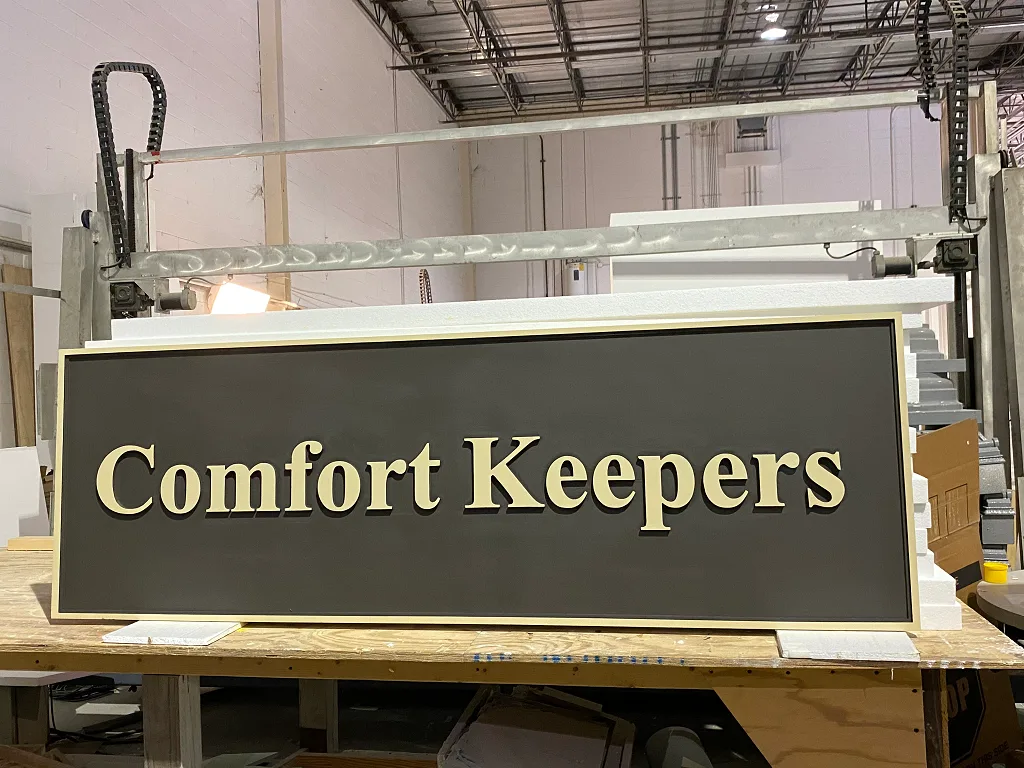
Non-illuminated dimensional signs – routed foam, fabricated aluminum, or acrylic dimensional letters and logos – provide strong daytime visibility at lower fabrication cost than illuminated alternatives, and are appropriate for businesses with primarily daytime operating hours or in locations where external architectural lighting or natural ambient illumination provides adequate nighttime sign visibility. For many professional service businesses (law firms, financial advisors, medical offices) in well-lit commercial environments, non-illuminated dimensional signs deliver excellent visibility without the electrical and permitting requirements of illuminated installations.
Projecting blade signs – signs mounted perpendicular to the building face rather than flat against it – are particularly effective in dense pedestrian retail environments where the facade-parallel sightline from down the sidewalk is the primary viewing angle. A well-designed blade sign is visible from both directions along a sidewalk as much as half a block away, while a facade-mounted sign of the same size may be invisible from that angle until the viewer is directly in front of the storefront. For businesses in urban retail corridors, pedestrian shopping districts, or any location where pedestrian approach from a sidewalk parallel to the building is the primary visibility challenge, blade signs often outperform larger facade signs.
Window graphics – vinyl lettering, printed window films, or perforated window graphics – are a cost-effective primary or supplementary sign format for ground-floor storefront businesses with large window areas. Window graphics turn the entire glass facade into a branded surface visible from the street, providing a large effective sign area at low cost. They’re not illuminated and don’t provide the dimensional quality of fabricated signs, but for businesses with large windows and limited facade depth for mounted signs, they solve the exterior visibility problem efficiently.
Specifying Exterior Business Signs for Your Location
Business signs outdoor specifications need to be determined by the actual viewing conditions at the specific installation location, not by general guidelines or default sizes from a catalog. The three primary viewing condition variables that determine appropriate sign specifications are viewing distance, traffic speed, and ambient light competition.
Viewing distance from the primary approach direction determines the minimum letter height and sign scale needed for reliable legibility. As a practical starting point: for walking-pace pedestrian viewing, letter heights of 4 to 6 inches are typically legible at typical storefront distances. For slow vehicle traffic in commercial areas (25-30 mph), minimum letter heights of 6 to 10 inches are generally needed. For fast arterial road viewing (40+ mph), letter heights of 12 inches or more may be necessary. The correct specification for any specific installation should be confirmed by standing at the primary approach viewing position and evaluating legibility at that actual distance.
Traffic speed affects both letter size requirements and the amount of information that can be effectively communicated. At pedestrian speeds, a sign can include a business name, tagline, and key service descriptor. At vehicle speeds of 35 mph, only the business name in large letters and possibly one brief secondary line of information can be processed reliably. Signs designed for vehicle-speed viewing that attempt to include extensive information consistently fail to communicate that information to drivers, because the viewing window is too short to read multiple lines of smaller text.
Ambient light competition determines the appropriate illumination specification. A sign installed on a busy commercial corridor with significant ambient illumination from street lighting, adjacent signage, and passing headlights needs either higher illumination brightness or stronger color contrast to stand out; a sign on a quieter street with low ambient illumination can achieve adequate nighttime visibility with standard LED module specifications.
Permitting requirements should be confirmed with the local building or zoning authority before finalizing any exterior sign specification, since most municipalities regulate commercial signage size, illumination type, and placement, and specifications that don’t comply with local ordinances will require modification after permitting review – adding time and cost to the project.
Materials, Durability, and Long-Term Performance
Exterior signs for business performance over time depends on material specification and fabrication quality more than on sign type. The most common exterior sign failures – fading, coating delamination, illumination failure, and mounting problems – are almost all preventable through correct material specification and fabrication practice.
UV-stabilized exterior topcoats on any painted sign element are non-negotiable for long-term color retention. Signs in direct sun exposure without UV-stabilized coatings begin visibly fading within one to two seasons, undermining the brand impression they were installed to create. Specifying UV-resistant coatings – and confirming with your sign fabricator what specific topcoat system they use for exterior applications – is the most important material quality question to establish before ordering any exterior painted sign.
Corrosion-resistant mounting hardware – stainless steel or hot-dip galvanized fasteners, brackets, and threaded rods – prevents the rust staining that standard zinc-plated hardware develops outdoors within a few seasons, creating visible brown stains on the building facade directly below each mounting point. For painted or finished facades where rust staining is difficult to clean without damaging the surface, using stainless hardware throughout is a meaningful quality decision with visible long-term consequences.
LED component quality in illuminated signs has significant variation between manufacturers, and lower-quality LED modules can fail in uneven patterns within a few years of installation – creating visible dark spots or sections within individual letters that require module replacement to correct. Asking your sign company what LED brand and quality tier they use for exterior illuminated signs, and what warranty they provide on the LED components specifically, is the right question to ask before committing to any illuminated exterior sign installation.
Conclusion
The honest takeaway on exterior business signs is that they’re one of the few marketing investments where doing it right once delivers compounding returns over many years without ongoing cost. The businesses that get the most from their exterior signage are the ones that specify correctly for their actual viewing conditions – not defaulting to standard catalog sizes – and that choose a fabricator who uses proper exterior coating systems and warrants their materials accordingly. A sign that looks exactly right from the street-level viewing position, maintains its color and brightness for a decade, and stays securely mounted through whatever weather your location delivers is the goal. Everything else in the specification process is working toward that outcome.
Frequently Asked Questions
What types of exterior business signs are most effective?
Channel letters are the most effective choice for businesses needing dual day-and-night visibility, particularly in retail, restaurant, and service sectors with extended operating hours. Non-illuminated dimensional signs are effective for daytime-focused professional businesses in well-lit commercial environments. Projecting blade signs outperform facade-mounted signs in dense pedestrian corridors where the primary approach angle is parallel to the building face. The right type depends on viewing distance, traffic speed, operating hours, and the specific approach angles of the primary customer audience.
How far should an exterior business sign be readable from?
Readability distance depends on letter height – as a general starting point, each inch of letter height provides approximately ten feet of comfortable legibility distance under good lighting conditions. A sign with 6-inch letters is readable at approximately 60 feet; 12-inch letters at 120 feet. For vehicle traffic applications, the required reading distance should account for the driver’s reaction time at the posted speed limit, since a driver needs enough distance after reading the sign to safely slow and turn into the property.
Do exterior business signs require permits?
Most municipalities require permits for new commercial exterior signage, with regulations covering maximum size, illumination type and brightness, placement relative to property lines, and in some districts, design review. Permit requirements and processing times vary significantly by jurisdiction. Working with a sign company experienced with your local permitting process is the most efficient approach – they know what will be approved, what documentation is required, and how long the process typically takes.
How long do exterior business signs last?
Properly fabricated exterior signs with UV-stabilized coatings, corrosion-resistant hardware, and quality LED components (for illuminated signs) commonly last 10 or more years before requiring significant maintenance or replacement. Signs that fail prematurely almost always do so because of inadequate coating specification, undersized fasteners, or low-quality LED modules – all preventable through correct specification upfront and the right fabrication partner.
Read more

Acrylic Letters and Logo Signs: A Practical Guide for Business Owners

Foam Routed Signs and CNC-Cut Signage: When and Why Businesses Choose This Format

Hanging Signs for Trade Show Booths: Weight, Rigging, and Sightlines That Work
Oversized Foam Letters for Events, Retail Displays, and Brand Activations
PVC, Acrylic, or Small Metal Letters: Choosing the Right Dimensional Letters for Your Storefront

Foam Sculptures and Oversized Product Replicas: How Brands Build Unmissable Experiential Marketing

How Backlit and Halo-Lit Signs Turn a Storefront Into a Landmark After Dark
Digital Signage for Business: What It Is and How to Use It Effectively
Sandblasted and V-Carved Signs: The Craft Behind Timeless, Hand-Finished Business Signage

Floating Pool Letters: A Fresh Way to Brand Pool Parties, Resorts, and Brand Activations

Premium 3D Dimensional Signage with Professional Lighting Solutions
Safety and Warning Signs for the Workplace: A Complete Guide for Business Owners
Recommended Articles
Acrylic Letters and Logo Signs: A Practical Guide for Business Owners
Foam Routed Signs and CNC-Cut Signage: When and Why Businesses Choose This Format
Hanging Signs for Trade Show Booths: Weight, Rigging, and Sightlines That Work
Oversized Foam Letters for Events, Retail Displays, and Brand Activations
PVC, Acrylic, or Small Metal Letters: Choosing the Right Dimensional Letters for Your Storefront
Foam Sculptures and Oversized Product Replicas: How Brands Build Unmissable Experiential Marketing