How to Order Custom Signs for Your Business
How to Order Custom Signs for Your Business: A Step-by-Step Guide
A marketing manager at a regional fitness chain recently spent six weeks going back and forth with three different sign vendors before placing a single order. The first vendor quoted a price without asking what surface the signs would mount to. The second produced a proof with the wrong logo file – the client had sent a low-resolution PNG instead of a vector, and the vendor used it anyway. The third finally delivered a complete, accurate quote and proof, but only after the client had wasted time with the first two. None of this was unusual, according to the project manager who eventually got the job done. What was unusual was how preventable every delay had been: each one traced back to a gap in the ordering process, either on the client’s side or the vendor’s. Custom signs are not an impulse purchase, and the businesses that order them most efficiently are the ones that understand the process before they start it. This guide walks through exactly how ordering works, what information you need to have ready, and how to avoid the delays that make sign projects take longer than they should.
What to Prepare Before Contacting a Sign Company
The most common reason custom sign orders take longer than expected isn’t production time – it’s the back-and-forth that happens before production even begins, while the client and vendor work out information that should have been established in the first conversation. Preparing this information before making contact with any sign company compresses a process that typically takes days of email exchanges into a single productive consultation.
Your logo in vector format is the single most important file to have ready before any sign inquiry. Custom signs are produced at physical scale, and artwork that looks fine on a screen or in a printed document may have a resolution far too low for sign production. Vector files – typically AI, EPS, SVG, or PDF formats created in Adobe Illustrator or similar software – contain mathematical descriptions of shapes rather than pixel grids, meaning they can be scaled to any size without quality loss. If your business only has a logo in PNG or JPG format, a sign company can often redraw it in vector, but this adds cost and time to the project. Finding or requesting the vector version from whoever created your logo before you begin the sign ordering process eliminates this common delay.
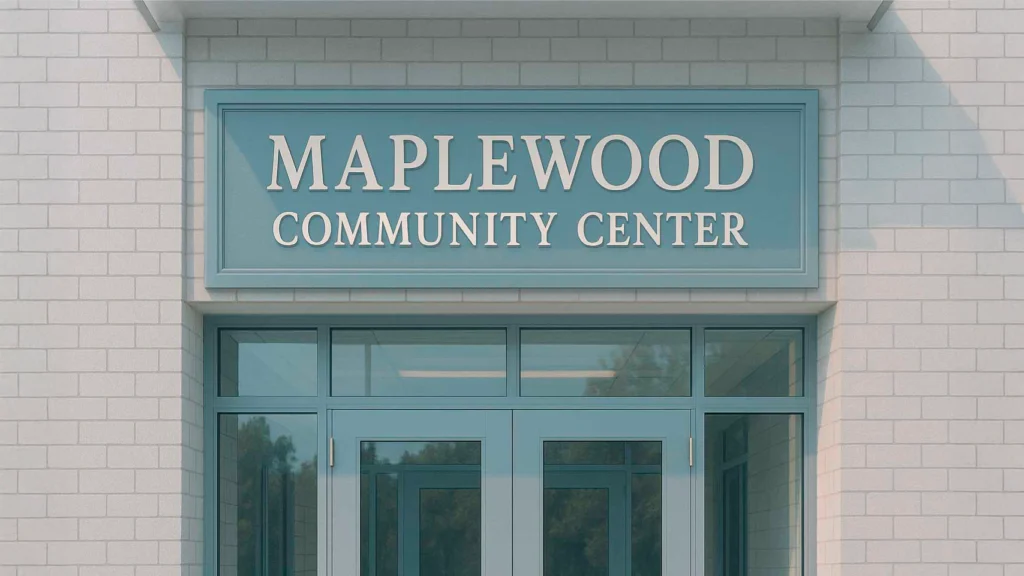
Dimensions and mounting location details need to be confirmed before any quote can be accurate. Sign companies need to know the exact space available for the sign, what surface it will mount to (drywall, masonry, aluminum composite panel, glass), and whether there are any obstructions, electrical boxes, or structural elements within the sign area that affect placement. For building exterior signs, knowing the mounting height above grade, the wall construction type, and whether electrical conduit access is available for illuminated signs are all questions that will need to be answered – better to gather this information before the first call than to discover it’s missing when a quote arrives and additional field verification is needed.
Your timeline and budget range are parameters that help a sign company for business recommend appropriate solutions rather than presenting options across the full range of what’s possible. Sign production timelines vary significantly based on complexity, material, and fabrication method – a simple routed foam sign can be produced in days, while a large illuminated channel letter installation with permitting and electrical work may take six to eight weeks. Communicating timeline requirements upfront allows a sign company to flag whether your timeline is achievable and what tradeoffs, if any, are needed to meet it.
Reference examples of sign types and styles you’re drawn to are useful context even if you can’t fully articulate why. Most business sign projects start with a general visual direction – dimensional vs. flat, illuminated vs. non-illuminated, traditional vs. contemporary – and being able to point to examples of signs you like gives a sign designer a useful starting point. Even photos taken of signage you’ve noticed in your market area that made an impression communicate more efficiently than written style descriptions.
The Quote and Proof Process: What to Expect and What to Review
Once you’ve provided the initial information, a credible sign company should produce a written quote and a design proof – a visual rendering of the proposed sign – before any production begins. Understanding what these documents should contain helps you evaluate them accurately and catch problems before they become expensive corrections.
A complete written quote for custom signs should itemize the sign type and materials, dimensions, fabrication method, finish specification (paint colors, powder coat, coating system for outdoor elements), mounting hardware and method, installation (if included), permitting (if applicable), and timeline. A quote that gives only a total price without this breakdown makes it impossible to compare across vendors or to understand what you’re actually purchasing. Vague quotes from sign vendors are frequently a precursor to scope disputes after the project is underway – request line-item detail before signing off on any sign order.
Design proofs should be reviewed against several specific criteria before approval: Is the logo reproduced accurately, using the correct typeface, proportions, and color values from your brand standards? Are the dimensions shown in the proof consistent with the dimensions in the quote and with the available space at the installation location? Does the proof show how the sign will actually appear on the wall or surface – ideally as a scaled image against a photo of the actual mounting location? Any discrepancy between the proof and the intended installation context should be clarified before approval, since once production begins, changes become costly.
Color specification deserves specific attention in the proof review. Screen colors are notoriously unreliable for predicting physical paint or material colors. For critical brand color matches, request a physical paint chip or Pantone match specification in the quote rather than relying on the proof rendering’s on-screen color appearance. Business signage near me searches often lead businesses to local vendors precisely because being able to see physical material and color samples before ordering is genuinely valuable for getting color accuracy right.
Approval and revision protocols should be confirmed before you begin: how many proof revisions are included in the quote, what triggers additional charges, and what constitutes final approval that authorizes production. Many sign companies use digital approval signatures on proofs as the trigger for material ordering and production scheduling, so understanding what you’re approving and when is important – particularly on projects where design decisions might need input from multiple stakeholders.
Production, Installation, and Common Causes of Delay
Understanding what happens during sign production and installation, and what commonly causes projects to run longer than quoted, helps you manage the process from the client side and reduces the chance of being surprised by a schedule slip.
Material lead times are the most common cause of production delays on custom sign projects. Specialty materials – specific acrylic colors, particular aluminum profiles, LED modules from a specific manufacturer – may have lead times of several weeks if they’re not in the vendor’s stock. This is particularly relevant for sign projects being planned around a specific opening date or event: the further in advance you initiate the order, the more buffer exists between material arrival and your deadline. Sign companies for business that are experienced with deadline-sensitive projects will flag long-lead materials during the quoting stage rather than discovering them after order placement.
Permitting timelines for illuminated signs and monument signs require separate consideration from fabrication timelines. Most municipalities require permits for new illuminated commercial signage, and permit processing times vary from a few days to several weeks depending on the jurisdiction, the complexity of the sign, and whether the project is in a district with design review requirements. Experienced sign companies handle permitting as a standard part of the project and factor permit timelines into their overall schedule, but clients who assume installation can begin immediately after fabrication completes on a permitted sign project consistently encounter disappointment.
Installation scheduling and site readiness are the final variables that affect overall project timeline. For exterior building signs, site readiness means the mounting surface is complete, any required electrical rough-in is done, and access equipment (if needed for height) is arranged. Installation delays caused by site conditions that weren’t ready – a facade not yet painted, an electrical connection not roughed in, a tenant space not yet accessible – are typically the client’s responsibility and don’t trigger any compensation from the sign company for the resulting delay.
Change orders after production begins are among the most expensive and schedule-disrupting events in any sign project. A dimension change, a logo revision, or a color correction requested after materials have been ordered or fabrication has begun typically requires a change order that adds cost and restarts part of the fabrication timeline. The most effective way to avoid change orders is thoroughness at the proof approval stage – treating the design proof review as the last opportunity for zero-cost changes, which it is.
How to Evaluate Sign Companies and Get the Right Result
The sign company you choose has as much influence on your project outcome as the sign type and materials you specify. Evaluating vendors before committing is time well spent on any sign project of meaningful scale.
Portfolio of comparable projects is the most direct evidence of a sign company’s capabilities. Ask specifically to see examples of sign types similar to what you’re ordering – not just their most impressive work across all categories. A company that produces outstanding vehicle wraps but has limited experience with dimensional letter fabrication and installation is not the same thing as a company with demonstrated expertise in your specific sign category.
References from clients with similar projects are worth requesting and actually calling. A sign company near me that has installed dozens of dimensional signs on building facades in your local market knows the local permitting requirements, the common wall construction types in your area, and the weather conditions their products need to perform in – advantages that an out-of-area vendor may not have. References specifically from clients whose projects involved exterior installation in your climate zone are more relevant than references from interior sign projects.
Warranty terms should be reviewed before contract signing. What does the warranty cover, for how long, and what does it exclude? For exterior signs specifically, UV fade resistance, coating adhesion, and weatherproofing performance are the most important warranty considerations. A vendor who offers a meaningful exterior warranty on their materials and workmanship is demonstrating confidence in their products that a vendor with only a short-term workmanship warranty is not.
Conclusion
The honest takeaway on ordering custom business signs is that the businesses that get the best results are the ones that treat the preparation and proof review phases as carefully as they treat the physical sign installation itself. Every expensive correction, every schedule slip, and every disappointed expectation in a sign project traces back to information that wasn’t confirmed before production began. Prepare your files, confirm your dimensions, review your proof against your actual brand standards and installation location, and ask your vendor specific questions about material lead times and permitting timelines before you approve anything. Do all of that, and a custom sign order becomes a straightforward process rather than a six-week email chain.
Frequently Asked Questions
How do I order custom signs for my business?
Start by preparing your vector logo files, confirmed dimensions for the sign location, surface material details for the mounting area, and a clear timeline and budget range before contacting sign vendors. A sign company should then provide a written quote with line-item detail and a design proof for your review and approval before production begins. The approval of that proof is the trigger for material ordering and fabrication, so review it carefully against your brand standards and the actual installation location before signing off.
What information does a sign company need from me?
The minimum information a sign company needs to produce an accurate quote is: your logo in vector format, the dimensions of the available sign space, the mounting surface material, whether the sign is interior or exterior, and whether illumination is required. Timeline and budget parameters allow the vendor to tailor recommendations to your specific constraints. The more complete this information is when you make first contact, the faster and more accurate the initial quote will be.
How long does it take to produce custom business signs?
Production timelines range from a few days for simple interior signs to six to eight weeks or more for large illuminated exterior signs that require permitting and electrical work. The timeline depends on sign type, material availability, fabrication complexity, and whether permits are required. For any sign project tied to a specific deadline – a grand opening, a lease commencement date, an event – initiate the ordering process with as much lead time as possible and confirm the production and permitting timeline with your vendor before placing the order.
Can I find a sign company near me for local installation?
Yes, and for exterior building signs specifically, a local sign company has meaningful advantages: familiarity with local permitting requirements, knowledge of building types and construction methods common in your area, and the ability to visit the installation site for accurate measurements and surface assessment. For interior signs or signs that don’t require on-site installation, the vendor’s geographic location matters less, and the quality of their fabrication and their experience with your specific sign type are more important selection criteria.
Read more
Foam Routed Signs and CNC-Cut Signage: When and Why Businesses Choose This Format
Hanging Signs for Trade Show Booths: Weight, Rigging, and Sightlines That Work
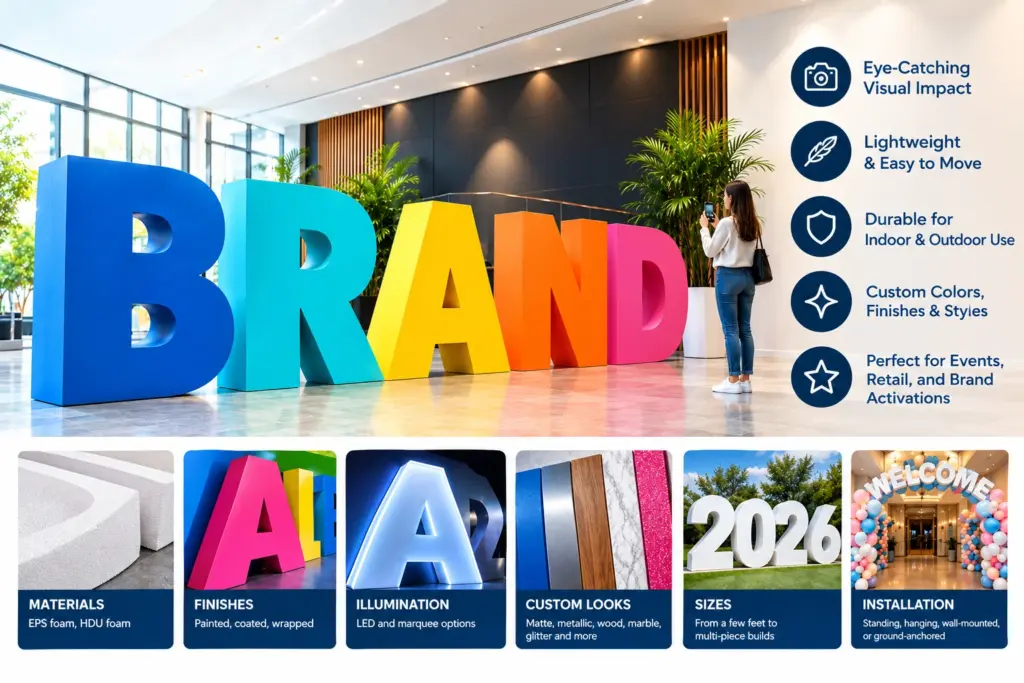
Oversized Foam Letters for Events, Retail Displays, and Brand Activations
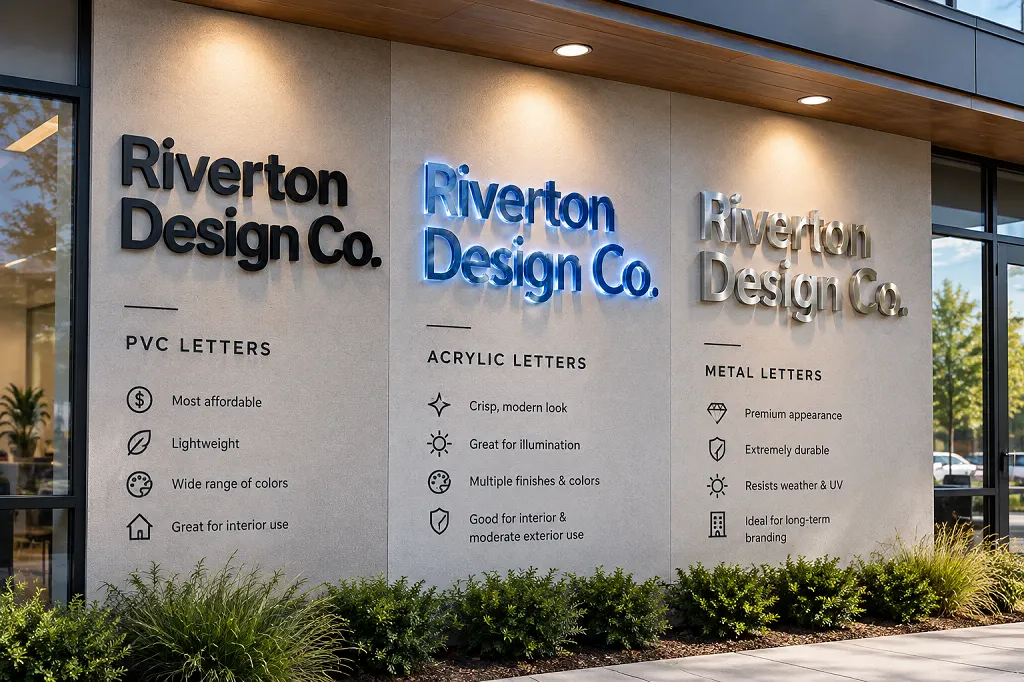
PVC, Acrylic, or Small Metal Letters: Choosing the Right Dimensional Letters for Your Storefront
Foam Sculptures and Oversized Product Replicas: How Brands Build Unmissable Experiential Marketing
How Backlit and Halo-Lit Signs Turn a Storefront Into a Landmark After Dark
Digital Signage for Business: What It Is and How to Use It Effectively
Sandblasted and V-Carved Signs: The Craft Behind Timeless, Hand-Finished Business Signage
Floating Pool Letters: A Fresh Way to Brand Pool Parties, Resorts, and Brand Activations
Premium 3D Dimensional Signage with Professional Lighting Solutions
Safety and Warning Signs for the Workplace: A Complete Guide for Business Owners
Massive 3D Dimensional Signage That Commands Attention
Recommended Articles
Foam Routed Signs and CNC-Cut Signage: When and Why Businesses Choose This Format
Hanging Signs for Trade Show Booths: Weight, Rigging, and Sightlines That Work
Oversized Foam Letters for Events, Retail Displays, and Brand Activations
PVC, Acrylic, or Small Metal Letters: Choosing the Right Dimensional Letters for Your Storefront
Foam Sculptures and Oversized Product Replicas: How Brands Build Unmissable Experiential Marketing
How Backlit and Halo-Lit Signs Turn a Storefront Into a Landmark After Dark