3D Foam Sculptures
Atmosphere matters in any business built around direct customer interaction. But modern customers have gotten used to increasingly immersive experiences from all kinds of attractions, so genuinely surprising them gets harder every year. One effective way to stand out is through custom foam shapes — a category we build as part of our core custom architectural foam direction at 3D Sign Factory.
The material we work with, expanded polystyrene, lets us build pretty much any shape or form a designer can dream up. Custom statues offer something traditional materials just can’t: the freedom to think big without getting bogged down by logistics, budget, or physical limitations.
What makes styrofoam sculptures the secret weapon of any company

This isn’t really about compromise. It’s about what opens up once material constraints stop dictating the creative vision.
Designers of advertising and interior sculptures have spent decades having to compromise, and that usually meant scaling back ambition somewhere. Scale, budget, deadlines — pick two, basically. Want it monumental? Set aside about six months and a real marketing budget for it. Need it fast instead? Keep it small and simple. 3D foam sculptures cut through most of that tension.
Expanded polystyrene (EPS) behaves differently from bronze, stone, HDU foam, or even fiberglass. A stone sculpture, for instance, drags in civil engineers and foundation work before anything gets built, while foam keeps both manufacturing and installation genuinely simple. Casting and finishing a metal sculpture can eat up several months; a foam option is ready in a few weeks instead. Fiberglass holds up fine too, but it’s heavier, and outdoor use usually means more complex installation and finishing work.
Foam designs are not just “faster, easier, cheaper” — though that undersells it a bit. EPS is easy enough to work with that it can visually imitate almost any material out there, with the help of our skilled craftsmen. A huge, realistic octopus for a theme park water attraction? Done. A “nearly real” stone castle at the entrance to a medieval-style fair? We’ll take that on too — just describe what you’re picturing and we’ll go from there.
How styrofoam sculptures overcome gravity and “biting” budgets
Take a physical problem every ambitious installation eventually runs into: weight. Say a tech conference center wants a ceiling decoration shaped like a 4-foot metal sphere. Order that in actual metal, and it turns into a headache for everyone involved — the owners, the designer, and whoever has to install it.
For one thing, a sphere that size is genuinely heavy. Even hollowed out for suspension, it would need reinforcement, a dedicated installation crew, and insurance to match. The same piece built from foam weighs a fraction as much, so it can be carried, moved, and mounted on standard ceiling systems without any of that extra fuss.
This weight advantage runs through the whole project:
- Delivery costs drop significantly.
- Installation teams shrink from specialized crews down to general contractors.
- Location flexibility opens up a lot. Shipping a metal sculpture to another city for a product launch would be costly and complicated — with a styrofoam sculpture, it’s just not an issue.
- Our finishing collection lets us build almost any texture, and it holds up looking genuinely real.
Here’s another nuance already hinted at above: large foam statues can float in the air in rooms where suspended structures once seemed impossible. If we can convincingly fake a metal ball, huge colorful butterflies are well within reach too. A cosmetics store once ordered a “flock” of them from us to decorate their salon for a summer sale. That same lightness is exactly why floral foam sculptures have become popular for weddings and receptions as well.
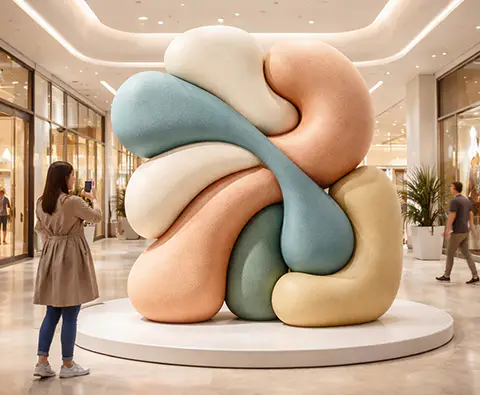
The budget side shifts just as much. Where a single sculpture in traditional materials might eat the entire installation budget, foam lets you build whole environments instead. Rather than one impressive piece, a designer can build “families” — Snow White and the dwarves for a children’s play center, say, or a lion with cubs at a zoo. Compositions like these entertain, sure, but they also quietly do advertising work: visitors photograph them and post them without anyone asking.
Where decorative statues can be applied
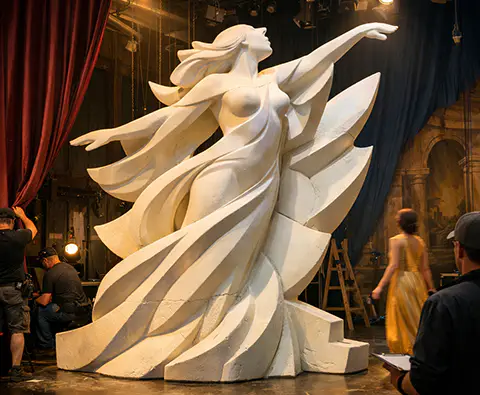
The versatility of 3D foam sculptures means they greatly enhance a wide variety of environments, from wedding sculptures to trade show booths:
- Retail environments and shopping malls;
- Theme parks and entertainment centers;
- Escape rooms and interactive attractions;
- Children’s parties and family entertainment;
- Corporate events and exhibitions;
- Conceptual and artistic installations.
Creative process without the stress
The creative workflow runs on its own rhythm, and traditional sculpture production rarely keeps up with it. Months of back-and-forth between concept approval and finished installation put real stress fractures into even well-organized projects. EPS production shortens that timeline considerably.
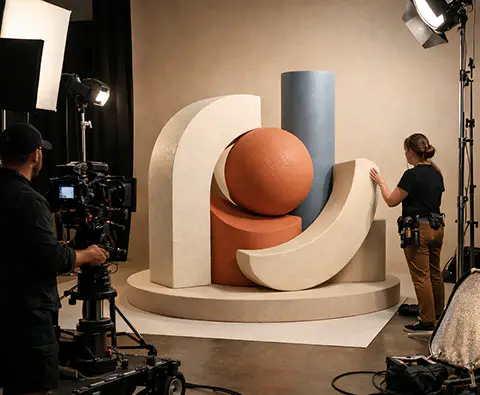
CNC cutting technology turns 3D models into physical forms in days, not weeks, and it gets there with an accuracy manual methods simply can’t touch — every curve and angle of the digital design comes through intact. Then artisans step in for what machines can’t do: subtle texture variation, hand-painted finishes. That level of refinement is what actually holds people’s attention.
Speed matters most when plans shift without warning. A product launch gets moved up three weeks. The space set aside for the sculpture opens earlier than planned. Design details get finalized at the last minute. High-quality styrofoam sculptures let you absorb that kind of chaos without it becoming a real crisis.
Styrofoam sculptures technical advantages that really matter to designers
Beyond the obvious wins — weight, speed — EPS carries properties that solve specific design problems you’ve probably run into before.
Weather resistance for outdoor installations
Outdoor sculptures used to mean choosing between something light but temporary, or something monolithic that demanded serious investment. What if you could get both? That’s more or less what EPS styrofoam sculptures deliver — durable pieces that shrug off the elements instead of looking fragile next to them.

The closed-cell structure of EPS repels water. Moisture doesn’t build up inside, and it doesn’t break down the material over time. Add protective coatings made for outdoor use, and you get sculptures that handle:
- rain,
- humidity,
- temperature swings, and
- UV exposure.
One example: a flamingo installation at a Florida resort that shrugs off tropical sun and afternoon storms without complaint. One of our winter installations in Chicago, meanwhile, handles snow, ice, and freezing wind just as well. EPS doesn’t rust like metal, doesn’t rot like wood, and doesn’t develop the spiderweb cracking that eventually shows up on outdoor fiberglass.
That durability goes beyond weather too. Public spaces bring their own wear and tear — accidental bumps from strollers and luggage, curious visitors testing things by hand, the slow buildup of thousands of touches and selfies over time. Our properly finished foam core sculptures hold up remarkably well against all of it. The material’s slight flexibility spreads out impact instead of letting it concentrate into crack points.
Even light and sound can be added
Modern installations increasingly build in technology. Think:
- LED light elements;
- projection mapping;
- sound;
- motion sensors;
- interactive elements.
You might need any of this for informational, educational, or purely entertainment reasons, depending on what the styrofoam sculpture is meant to do. Traditional materials tend to make these integrations a real headache — wiring into bronze or stone means drilling and compromise, and fiberglass, while hollow, offers limited room for modification.
EPS is different. Its structure lets technology get built in right from the design phase. Internal cavities hold wiring, LED matrices, speakers, and control systems without visible access panels or awkward surface mounting. Surfaces for projection mapping can be optimized during fabrication. Motion sensors slot right into the sculpture’s body.
A retail styrofoam sculpture might feature color-changing lighting that responds to how much movement is happening in the store. A theme park creature could trigger synchronized sound effects as visitors approach. Screens playing dynamic content inside the sculpture itself can anchor the center of an exhibition hall.
We stand out: why you should order styrofoam sculptures from us
The styrofoam sculpture industry has several capable fabricators, sure. But nearly 25 years of exclusive specialization in custom foams and foam art — the kind of architectural fabrication expertise that runs through every project we build — is what sets our company apart.
Where competitors treat foam as one service among several — mixing it with 3D printing, fiberglass, metalworking — 3D Sign Factory’s focus stays singular, and that shows in the finishing quality across thousands of projects. Combine that with the largest foam facility in Jacksonville, and you get results without the extended timelines that come from coordinating multiple disciplines at once.
Our production process runs on close collaboration with the customer — you’ll stay in the loop at every stage. It starts with a consultation. Bring detailed 3D models or a rough sketch on a napkin, either works fine; we’ll translate it into a realistic design either way.
Even early on, we account for the practical side — real logistics, real installation constraints. Will an 8-foot sculpture fit through a standard doorway? What mounting points does the room actually offer? How do multiple pieces connect so the joints disappear? These questions get answered during planning, not in a panic during installation.
Another thing that builds confidence early on: 3D visualization from our specialists. You’ll see exactly what you’re getting before manufacturing even starts, and if something needs adjusting, it happens at the digital stage — which saves money too.
Our 10-year warranty on foam products isn’t a marketing line. It reflects real material knowledge and finishing systems we’ve proven out over time. We keep project documentation on file throughout that period, which means we can reproduce damaged elements or modify existing installations down the road.
Ready to enliven your space?
If someone’s told you an installation idea is “impossible,” “too expensive,” or “would take too long,” it’s worth asking whether they actually know about EPS sculptures — or about us. Contact 3D Sign Factory today to request a free quote and discuss how styrofoam sculptures can turn your concept from a limited possibility into an unlimited reality.
Read more

Foam Routed Signs and CNC-Cut Signage: When and Why Businesses Choose This Format

Hanging Signs for Trade Show Booths: Weight, Rigging, and Sightlines That Work

Oversized Foam Letters for Events, Retail Displays, and Brand Activations
PVC, Acrylic, or Small Metal Letters: Choosing the Right Dimensional Letters for Your Storefront
Foam Sculptures and Oversized Product Replicas: How Brands Build Unmissable Experiential Marketing

How Backlit and Halo-Lit Signs Turn a Storefront Into a Landmark After Dark

Digital Signage for Business: What It Is and How to Use It Effectively
Sandblasted and V-Carved Signs: The Craft Behind Timeless, Hand-Finished Business Signage

Floating Pool Letters: A Fresh Way to Brand Pool Parties, Resorts, and Brand Activations

Premium 3D Dimensional Signage with Professional Lighting Solutions
Safety and Warning Signs for the Workplace: A Complete Guide for Business Owners
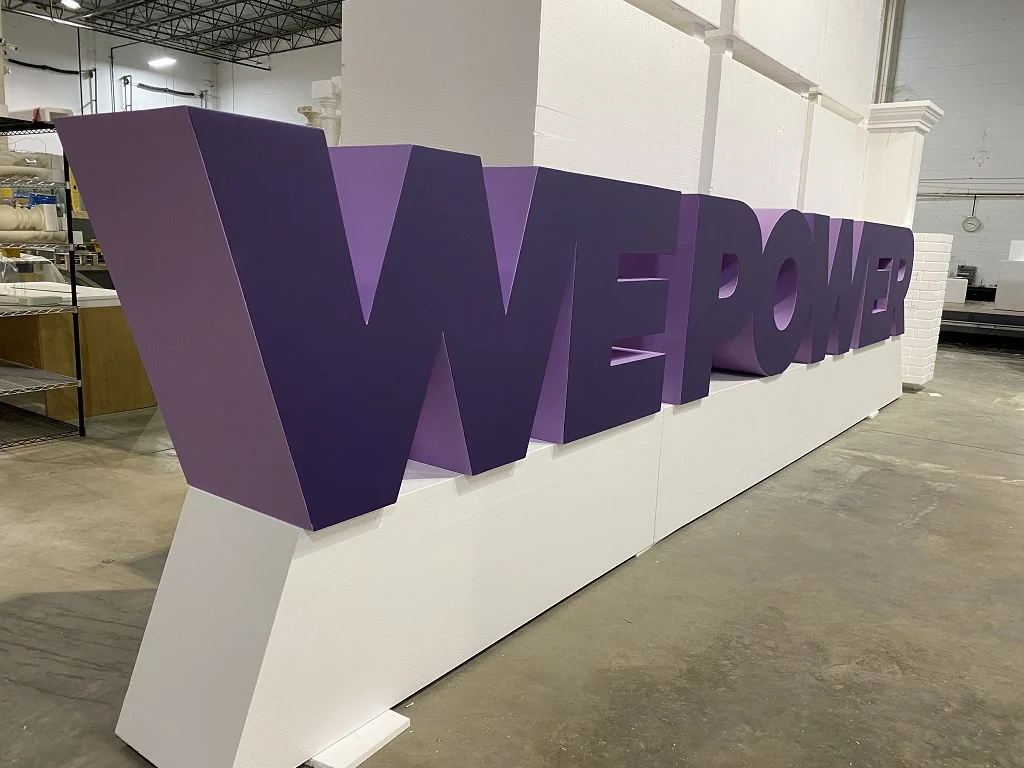
Massive 3D Dimensional Signage That Commands Attention
Recommended Articles
Foam Routed Signs and CNC-Cut Signage: When and Why Businesses Choose This Format
Hanging Signs for Trade Show Booths: Weight, Rigging, and Sightlines That Work
Oversized Foam Letters for Events, Retail Displays, and Brand Activations
PVC, Acrylic, or Small Metal Letters: Choosing the Right Dimensional Letters for Your Storefront
Foam Sculptures and Oversized Product Replicas: How Brands Build Unmissable Experiential Marketing
How Backlit and Halo-Lit Signs Turn a Storefront Into a Landmark After Dark