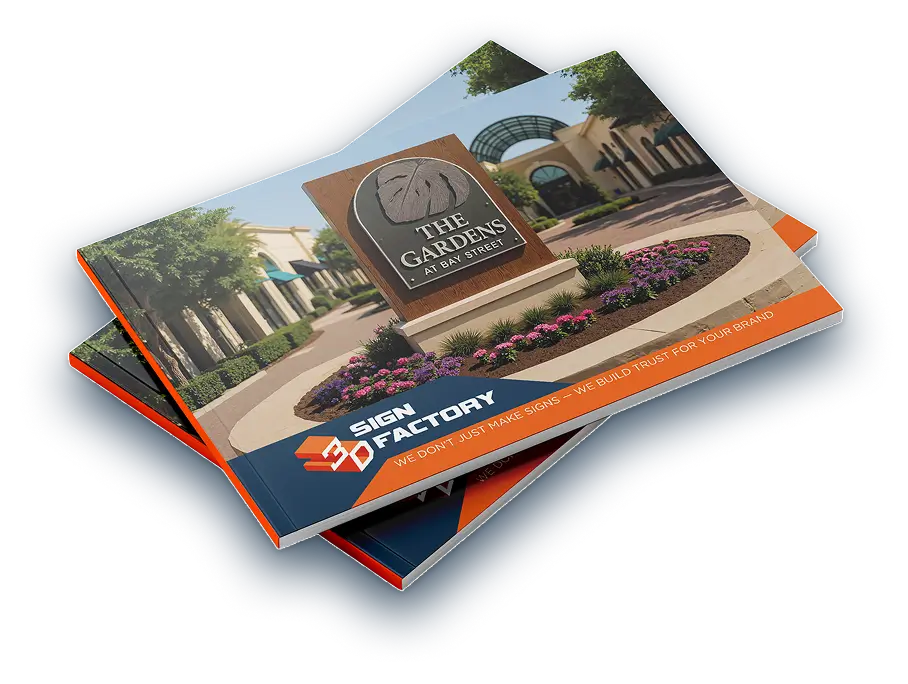
Custom Monument Signs for Businesses, Churches & Apartments
What a Foam Monument Sign Is and Why It Outperforms Traditional Options
A foam monument sign isn’t just another piece of signage placed in front of a building. In real-world projects, it’s often the first thing people notice — and the first thing they form an opinion about. That first impression tends to stick around longer than expected.
At first glance, traditional materials like concrete or masonry can look like the “safe” choice. In practice, though, they tend to introduce more limitations than advantages — weight, complex installation, higher costs, longer timelines. That’s where custom monument signs made from foam start to make a lot more sense.
Most of these signs are produced using EPS foam (Expanded Polystyrene) — the same custom architectural foam that runs through every 3D Sign Factory product line — a lightweight, rigid material made from expanded plastic beads. Despite being mostly air, EPS offers real structural stability while cutting weight dramatically. That makes it easier to transport, faster to install, and more flexible in design — complex shapes and realistic finishes become possible without the burden of heavy materials.

In real projects, that mix of efficiency, durability, and design freedom makes foam a genuinely practical alternative to traditional signage materials.
A modern custom exterior monument sign isn’t designed in isolation. It’s built around real conditions — the grade of the site, how traffic flows, how the building sits in space, even how drivers approach from the street. Break it down, and that level of adjustment is exactly what separates something that “looks acceptable” from something that actually works.
This is where 3D design becomes essential.
This kind of monument sign doesn’t remain static — it interacts with light, shadow, distance. It draws attention naturally. Not aggressively. In a controlled, effective way. In competitive locations, that makes a real difference.
Ultimately, outdoor monument signs built from foam tend to hit the balance most projects are chasing: visibility, practicality, and cost that actually makes sense.
The Advantages of Foam: Performance Without Compromise
Lightness that unlocks freedom
Weight becomes a constraint faster than people expect.
Foam monument signs can be dramatically lighter than concrete — in some cases, 70–90% less weight. That significantly cuts the need for heavy equipment, sometimes eliminating it entirely.
In many projects, access was tight, timelines were aggressive, and bringing in a crane just wasn’t realistic.
Foam solutions made the project feasible. Concrete wouldn’t have.
Strength against the elements
Lower weight doesn’t mean reduced strength — that assumption is common, but often misleading.
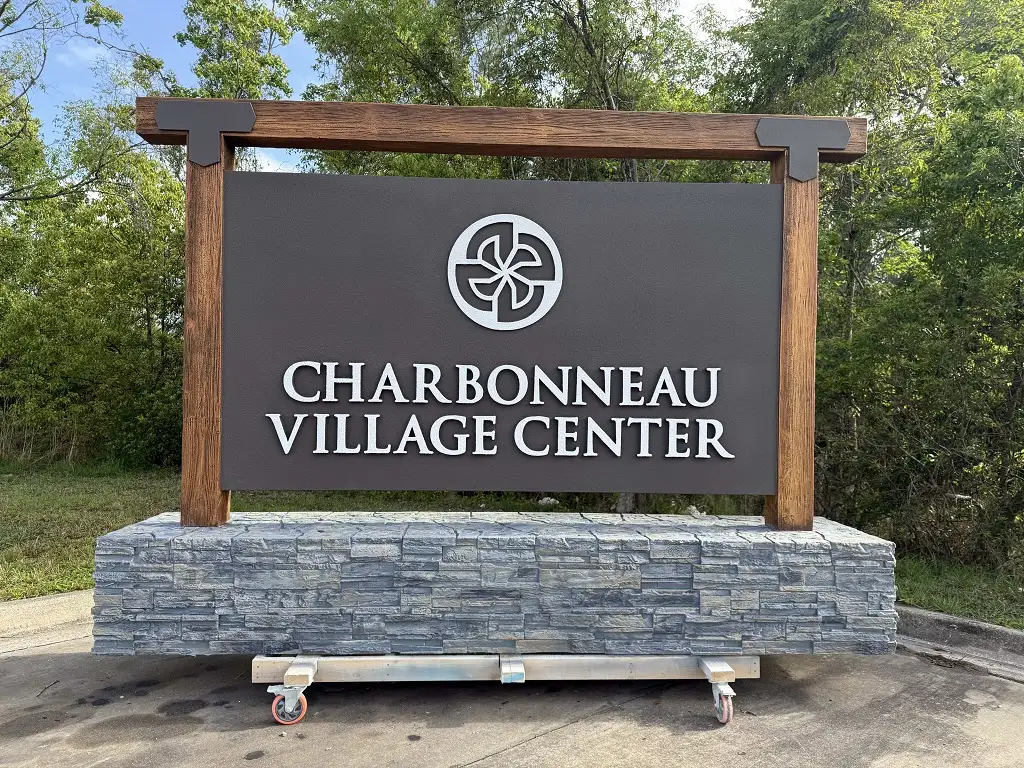
A properly built foam monument sign is layered. Coatings, reinforcement, sealing — it works as a system of integrated layers, not one material carrying the whole load.
In real conditions — sun, rain, temperature swings — these signs hold up.
That’s where quality shows itself over time.
Design without geometric limits
From a design standpoint, foam opens up options. Numerous monument sign ideas become achievable.
With custom monument signs, you’re not restricted by weight or rigidity the way you are with traditional materials. Curves, depth, layered shapes — all of that becomes far more achievable.
You get the look of something heavy and permanent, without the limitations that usually come with it.
Financial intelligence across a project’s lifecycle
From a business perspective, these advantages compound.
Business monument signs built from foam don’t just affect the fabrication cost — they influence the entire project, and that matters even more for large signs, where every logistical decision compounds.
Shipping tends to be simpler.
Sign installation moves faster.
There is less risk of project complications.
And in real projects, that’s usually what determines whether things stay on schedule… or don’t.
Realistic Finishes That Replicate Natural Materials
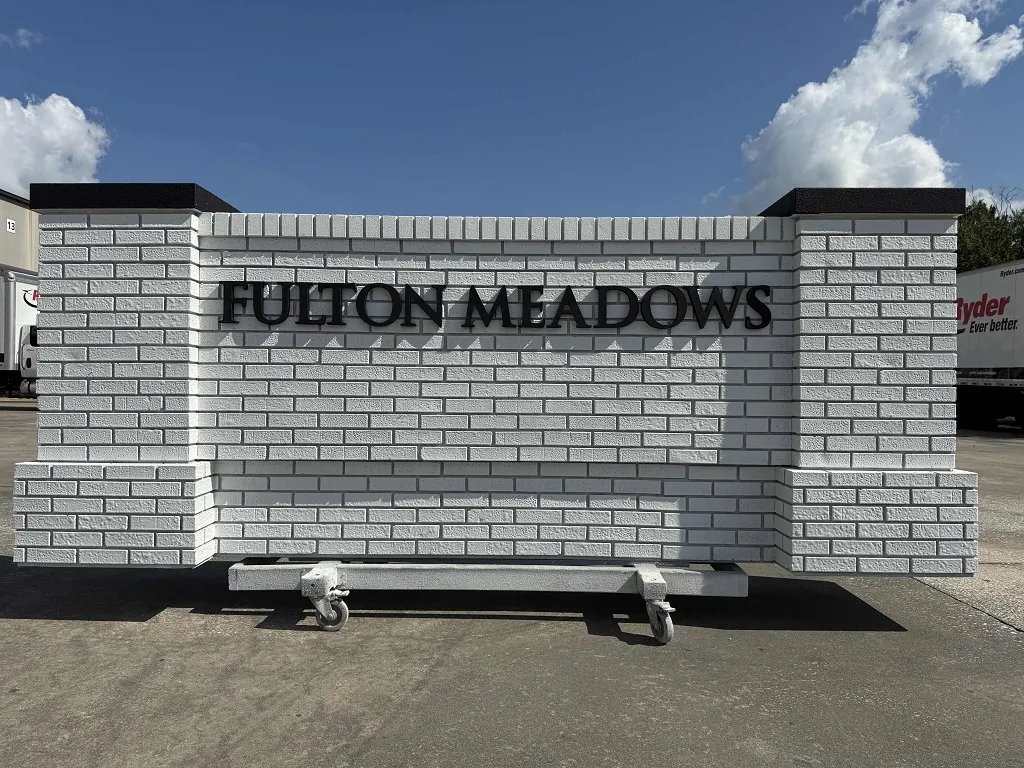
A well-executed custom foam monument sign can replicate stone or brick with surprising accuracy. Not just visually, but in how it feels.
In many cases, the finish is realistic enough that it invites tactile verification.
That moment usually says everything.
What Problems a Monument Sign Solves for a Property
From a practical perspective, a custom outdoor sign isn’t just about aesthetics — it’s about solving real, everyday problems that property owners deal with all the time.
First — navigation
If people don’t see your entrance monument signs in time, they miss it. That happens more often than most businesses think.
Especially on busy roads, people make decisions fast. If your signage isn’t clear and visible, they’re already past you before they even realize it.
At 3D Sign Factory, we worked with a small retail center off a high-traffic road in Florida where tenants kept hearing the same complaint — “We drove right past it.” The property technically had signage — a small monument sign, low, outdated, and easy to miss. We replaced it with a properly scaled foam core monument sign with better visibility and contrast. Within weeks, tenants started noticing fewer “missed turn” comments from customers, and foot traffic became a lot more consistent.
Second — brand visibility
Custom monument signs are always working. No off-hours. No campaigns to manage.
They don’t rely on clicks, impressions, or algorithms. They just show up, day in, day out.
And the best part? Once it’s installed, it keeps delivering without ongoing spend.
Third — perception
A clean, well-built large monument sign immediately elevates how a place is viewed. The effect is subtle but noticeable.
People may not always point it out directly — but it influences perception. It signals that the property is maintained, professional, and worth paying attention to. For outdoor business signs for buildings, first impressions really do start at the curb.
A medical office we worked with had great services and a solid location — but the exterior didn’t reflect that. Their old sign looked dated and didn’t match the building at all. We designed a custom foam monument sign with dimensional lettering and a finish that aligned with the architecture — nothing flashy, just clean and intentional. These kinds of business entrance signs are often the first real handshake with a client. The feedback? Patients started mentioning how “nice the place looked” before they even walked in. That first impression shifted, and it mattered.
And finally — longevity
A well-designed business signage solution holds up. A weak one becomes a replacement project sooner than expected.
Between weather, sun exposure (especially in places like Florida), and general wear, not every material performs the same over time.
Foam monument signs — properly coated and installed — hold up surprisingly well. You’re not constantly dealing with repairs, repainting, or structural issues.
The goal is simple: install it once, and don’t have to think about it again anytime soon.

Technologies for those who demand perfection
Every foam monument sign starts with planning, not cutting. This holds especially true for custom exterior monument signs, where planning determines almost everything downstream.
A CAD model defines proportions, mounting strategy, and structural behavior. It’s not just a visual reference — it’s how the sign will actually function.
Then comes CNC routing. This is where precision gets locked in.
If something’s off here, it shows later. Every time.
After that, coatings. Typically:
- reinforcement layer
- polyurethane coating
- polyurea hard coat
Thickness can reach up to 0.4 inches depending on exposure.
This is where many projects fail to meet performance expectations.
Not because of the foam — because coatings weren’t matched to the environment.
It’s a common issue in the industry.
Final step: texture and finish.
That’s where the piece either blends in… or stands out for the right reasons.
Comparison with Alternatives
When choosing materials for monument signs, the decision usually comes down to balancing performance, overall monument signs cost, and long-term practicality. Sounds simple — but in real life, it’s rarely that clean.
On paper, a lot of materials check the right boxes. In the field? That’s where things start to shift.
Material Comparison Overview
| Material | Weight | Installation Complexity | Durability (Weather/Time) | Maintenance Needs | Design Flexibility | Cost Range | Typical Use Case |
| EPS Foam | Very low | Fast & straightforward | High (with proper coating) | Low | Very high | Cost-effective | Monument signs, architectural features |
| Wood | Medium | Moderate | Medium (prone to rot/warp) | High | Medium | Moderate | Rustic or temporary signage |
| Concrete | Extremely high | Complex (heavy equipment required) | Very high | Low | Low | High | Permanent, heavy-duty structures |
| Metal | High | Complex | Medium–high (corrosion risk) | Medium | Medium | High | Industrial or modern signage |
What This Means in Real Projects
Here’s the thing — most materials look pretty similar until you actually have to install them. This shows up clearly in the classic monument sign vs pylon sign comparison, where ground-level presence and architectural detail tend to favor foam.
Once you’re dealing with real job sites, tight timelines, crew availability, and weather that doesn’t always cooperate, those “small” differences start to matter. A lot.
EPS foam monument sign solutions tend to hit a really practical middle ground — and honestly, that’s why they’ve become so common.
- Less weight
You’re not bringing in cranes or oversized crews. No heavy lifting, literally. That alone can make a project a lot easier to manage. - Simpler installs
Most crews can handle it without specialized equipment. No complicated setups, no waiting around for the right machinery. Signage installation goes faster as a result. - Fewer complications
No cracking like concrete. No warping like wood. No rust issues like metal. Less to worry about overall, and fewer callbacks down the road. - Design freedom
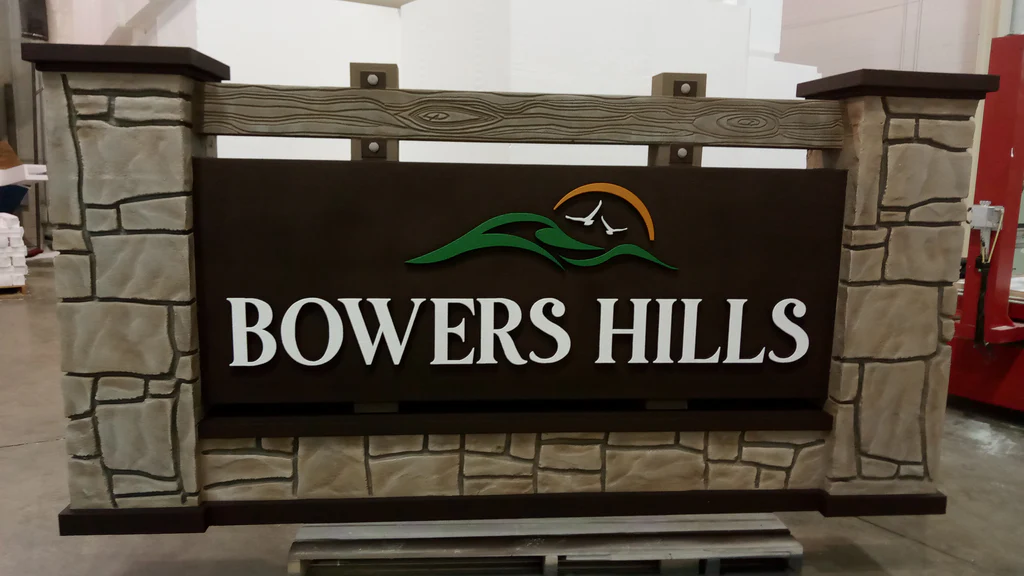
If you need custom shapes, a brick monument sign look, branding elements, or architectural detail, foam gives you way more flexibility. You’re not boxed into standard forms (which, let’s be honest, can get limiting fast). - Cost efficiency without cutting corners
You’re saving money, but not by sacrificing performance. With proper coatings, foam holds up really well against weather, UV, and day-to-day wear.
It’s not just about material cost — it’s about the whole picture: install time, labor, maintenance, and how the sign performs over time.
Foam checks a lot of those boxes. And then some.
It’s lighter. It installs faster. It keeps things simple.
And in most real-world projects, that’s what actually makes the difference.
Where foam monument signs are used
In commercial developments, business monument signs are used almost everywhere — exactly what local owners have in mind when searching for monument signs for business near me. Retail centers, office parks, and exterior wayfinding signs — visibility is key.
In residential settings, these monuments function as community signage, helping shape perception from the start. Multifamily properties also rely on solid apartment building signage to guide residents and visitors alike, and gated communities often look specifically for community entrance signs or HOA entrance signs that balance durability with curb appeal. Before someone sees the property, they see the entry.
Healthcare and education rely on clear, durable signage, often paired with exterior wayfinding signage across a campus, and the same standard applies to church monument signs at community worship spaces.
There’s not much room for error there — a hospital sign leaves none at all.
Hospitality projects lean into design, sometimes through custom welcome signs.
That’s where custom monument signs help define the overall feel of the space.
And in entertainment environments, dimensional monument sign elements often become part of the experience — not just a marker, but part of the story.
Why working with us makes sense
Large sign companies tend to follow fixed systems.
That works — until the project doesn’t fit those systems.
Real projects shift. Conditions change. Plans evolve.
And honestly, that’s just how it goes.
At 3D Sign Factory, every large monument sign project is treated as an engineering process — genuine architectural fabrication, not a catalog pick. Not a template. The same goes for custom business signs used elsewhere on a property — every piece gets the same level of attention.
Sometimes geometry changes mid-project.
Sometimes coatings get adjusted.
Sometimes installation drives design decisions.
That flexibility tends to lead to better outcomes.
Not just visually — but practically.
Engineering Notes
Lower-grade coatings tend to break down faster under UV — especially in southern climates.
Moisture becomes a factor quicker than expected, particularly near coastal areas.
Larger outdoor monument signs introduce wind load — and that needs to be considered early.
Installation is part of the system, not just the final step. Routed signs pricing depends on complexity and conditions, but lighter structures often reduce overall cost more than expected.
Conclusion
A foam monument sign isn’t just a sign — it’s part of how a business presents itself.
Custom monuments done right don’t just look good.
They solve real problems: visibility, perception, durability, cost. And when everything comes together — design, engineering, execution —
it performs as intended.
Ready to see what a properly engineered monument sign can do for your property? Contact 3D Sign Factory today to request a free quote.
Read more
Foam Routed Signs and CNC-Cut Signage: When and Why Businesses Choose This Format
Hanging Signs for Trade Show Booths: Weight, Rigging, and Sightlines That Work
Oversized Foam Letters for Events, Retail Displays, and Brand Activations
PVC, Acrylic, or Small Metal Letters: Choosing the Right Dimensional Letters for Your Storefront
Foam Sculptures and Oversized Product Replicas: How Brands Build Unmissable Experiential Marketing
How Backlit and Halo-Lit Signs Turn a Storefront Into a Landmark After Dark
Digital Signage for Business: What It Is and How to Use It Effectively
Sandblasted and V-Carved Signs: The Craft Behind Timeless, Hand-Finished Business Signage

Floating Pool Letters: A Fresh Way to Brand Pool Parties, Resorts, and Brand Activations

Premium 3D Dimensional Signage with Professional Lighting Solutions
Safety and Warning Signs for the Workplace: A Complete Guide for Business Owners
Massive 3D Dimensional Signage That Commands Attention
Recommended Articles
Foam Routed Signs and CNC-Cut Signage: When and Why Businesses Choose This Format
Hanging Signs for Trade Show Booths: Weight, Rigging, and Sightlines That Work
Oversized Foam Letters for Events, Retail Displays, and Brand Activations
PVC, Acrylic, or Small Metal Letters: Choosing the Right Dimensional Letters for Your Storefront
Foam Sculptures and Oversized Product Replicas: How Brands Build Unmissable Experiential Marketing
How Backlit and Halo-Lit Signs Turn a Storefront Into a Landmark After Dark